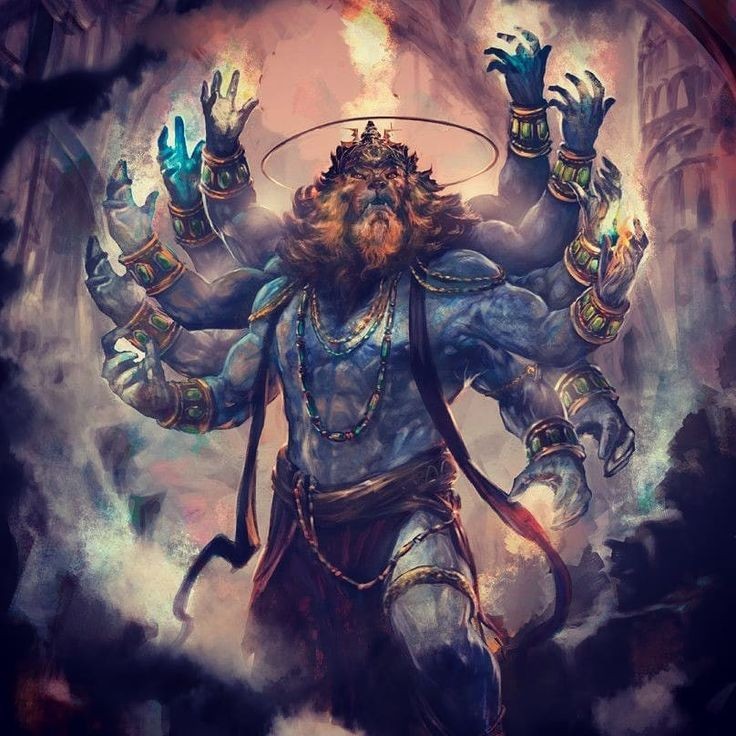
In the vast tapestry of Hindu mythology, the incarnations of Lord Vishnu stand as radiant avatars, each bearing a unique purpose and message. Among them, Lord Narasimha, the half-man and half-lion incarnation, emerges as a symbol of divine protection and justice. His awe-inspiring form and resounding roar encapsulate the power that can overcome any adversity. This article delves into the divine narrative of Lord Narasimha, his significance in Hinduism, and the potent symbolism behind his mighty roar that can bring down one’s enemies.
The Divine Narrative:
The story of Lord Narasimha is recounted in the Bhagavata Purana, a sacred scripture that portrays the tales of various incarnations of Lord Vishnu. The narrative unfolds in the context of the demon king Hiranyakashipu, who sought to attain invincibility through severe penance. With his boons from Lord Brahma, he believed himself to be above all divine and earthly forces, demanding that he be worshipped as a god. However, his own son Prahlada remained steadfast in his devotion to Lord Vishnu.
Hiranyakashipu’s increasing fury towards his son’s defiance led him to attempt numerous ways to eliminate Prahlada. But the divine protection that enveloped Prahlada thwarted all such endeavors. Frustrated beyond measure, the demon king resorted to seeking the aid of his sister Holika, who possessed a boon of being unharmed by fire. Their sinister plan to burn Prahlada alive was thwarted by Vishnu’s grace, as Holika perished while Prahlada emerged unscathed.
The Roar that Resonates:
Faced with relentless defiance and growing threats to his rule, Hiranyakashipu challenged the very existence of Vishnu, demanding to know whether the divine force resided in pillars and elements. In response to this audacious inquiry, Lord Narasimha emerged from a pillar, embodying a form that defied classification – neither fully human nor fully animal.
The pivotal moment arrived as dusk, the time when neither day nor night prevailed. This choice symbolized the gray area between the realms of the living and the divine, where Narasimha’s hybrid form could rightfully exist. With the sound of a tumultuous roar, he proclaimed the vanquishing of Hiranyakashipu’s arrogance and the restoration of dharma. The Shlokas from the Bhagavat Purana(7.8.22-23) reverberate the essence of this moment:
यदा यदा हि धर्मस्य ग्लानिर्भवति भारत ।
अभ्युत्थानमधर्मस्य तदात्मानं सृजाम्यहम् ।।
परित्राणाय साधूनां विनाशाय च दुष्कृताम् ।
धर्मसंस्थापनार्थाय सम्भवामि युगे युगे ।।
The Power of Roar:
Narasimha’s roar is symbolic of his transcendence beyond normality. It echoes through time and space, signifying his indomitable might and ability to overcome any challenge. In Hindu cosmology, sound is seen as a vibrational manifestation of divine energy. The Shloka (3.8.24) further emphasizes this concept:
नृसिंहस्य वदने वदनिर्विषण्णायात्र मुरारेः शिरोरुहाय ।
पदैर्जनायन नखैरनघाय दंष्ट्रया सम्भ्रामयन्नभिष्टुतां त्वाम् ।।
The roar of Narasimha, which emanated as a response to Hiranyakashipu’s challenge, serves as a reminder of divine intervention and justice. It signifies that no tyranny or injustice can escape the scrutiny of cosmic forces aligned with dharma.
Lord Narasimha’s incarnation is a testament to the profound beliefs and ideals of Hinduism. His unique form, born of necessity, resonates with the underlying truth that divine intervention exists to protect righteousness and vanquish malevolence. The power of his roar symbolizes the essence of his mission – to restore balance, ensure justice, and safeguard devotees from harm. The story of Lord Narasimha continues to inspire believers to face their challenges with unwavering faith and the knowledge that the divine roar can bring down even the mightiest of adversaries.

 Bharat Chronicles - Navigating Politics, Heritage and Beyond