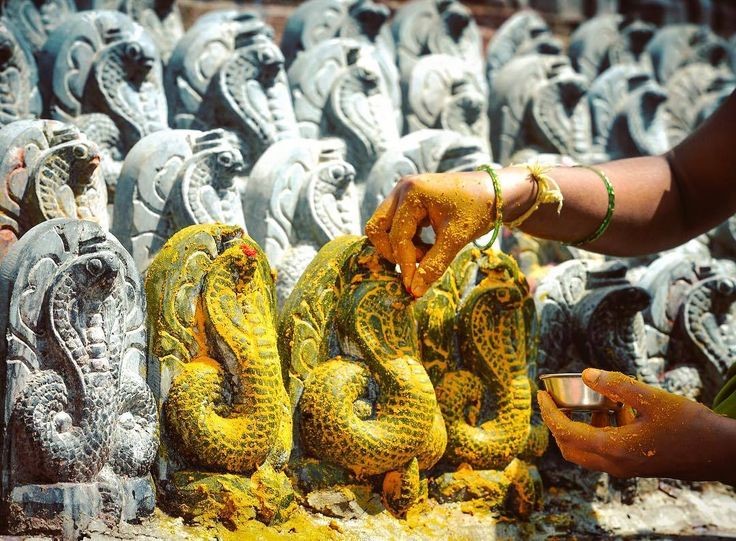
Naga Panchami, a prominent Hindu festival, holds immense significance in the cultural and religious tapestry of India. Celebrated on the fifth day of the bright half of the lunar month of Shravana, this festival is dedicated to the veneration of serpent deities, also known as Nagas. The worship of Nagas transcends geographical boundaries and has gained popularity across the world due to its spiritual, mythological, and ecological significance.
Mythological Roots and Significance
Naga Panchami’s roots can be traced back to Hindu mythology, where serpents play a crucial role as protectors and powerful beings. It is believed that Nagas hold a special place in the divine order, and they are closely associated with Lord Shiva and Lord Vishnu. The festival finds mention in ancient scriptures like the Puranas, where the benevolence and might of Nagas are extolled. The serpentine form is often associated with the cosmic energy and is considered a representation of Kundalini energy within human beings.
Ritual Observances
On Naga Panchami, devotees pay homage to Nagas by offering milk, turmeric, flowers, and prayers. Images or idols of serpents are adorned and worshipped, and some also create intricate designs known as Rangoli with rice flour depicting serpents. Special mantras and hymns are chanted to invoke the blessings of these powerful deities. In some regions, live cobras are worshipped and carried in processions as a mark of devotion.
Global Celebration and Adaptation
The reverence for Nagas isn’t confined to India alone. With the Indian diaspora spreading across the world, Naga Panchami has found its way into various cultures and communities. In countries like Nepal, Sri Lanka, and Indonesia, where Hinduism has a historical presence, Naga Panchami is celebrated with enthusiasm. Moreover, the festival’s universal themes of protection, transformation, and ecological balance have resonated with people from diverse backgrounds.
In places like Mauritius, Fiji, and Trinidad and Tobago, where Indian traditions have been preserved, Naga Panchami is celebrated with fervor. Communities come together to perform rituals, share traditional dishes, and educate the younger generation about the festival’s significance.
Ecological Significance and Conservation
The symbolism of serpents in Hinduism extends beyond mythology. Serpents play a crucial role in maintaining ecological balance by controlling rodent populations. Naga Panchami acts as a reminder of the importance of preserving these creatures and the ecosystems they inhabit. In recent times, efforts have been made to promote awareness about the conservation of snake species, as they often face threats due to habitat destruction and human fears.
Naga Panchami, with its roots in Hindu mythology and its global celebration, showcases the enduring influence of ancient traditions on contemporary society. The festival’s celebration serves as a bridge between cultural heritage and modern values, emphasizing the need to protect not only traditional practices but also the natural world. As communities across the world come together to venerate the serpent deities, Naga Panchami remains a testimony to the universality of spiritual ideals and the significance of unity in diversity.

 Bharat Chronicles - Navigating Politics, Heritage and Beyond